
北方有佳人, From the north comes a ravishing maiden,
絕世而獨立. Whose beauty stands alone.
一顧傾人城, One look at her, cities fall,
再顧傾人國. On the other glance, empires collapse.
寧不知傾城與傾國 Care not whether cities fall or empires collapse,
佳人難再得 Such beauty never comes around twice
佳人曲, The Beauty Song
李延年 Li Yannian (Western Han Dynasty poet, ca. 1st century B.C.)
This very famous verse of Li Yannian, musician and poet of Western Han Dynasty court of Emperor Wu Di (who allegedly had homosexual relationship with emperor), can be attributed to each of Four Famous Beauties of Ancient China. Diaochan 貂蝉 is the only one of them with no references in historical records, except the fact, that outstanding warrior of the time, Lü Bu, had affair with one of his foster father Dong Zhuo concubines. But in folk tales, cultural heritage and 14th century “Romance of Three Kingdoms” her character depicted so vividly, that there is no doubt this famous Three Kingdoms beauty prototype existed in history.
The name “Diaochan”(貂蝉), that is literally translated as “sable cicada”, according to one version comes from the sable tails and jade decorations on the hats of high-ranking officials in the Eastern Han court in the shape of cicadas. In famous theatrical performancy Lianhuan Ji (連環計 ), created in the Yuan Dynasty, Diaochan is daughter of Ren Ang (任昂 ), and her real name is Ren Hongchang (任紅昌 ). She was in charge of Sable Cicada Hat (貂蟬冠 ), so her name became “Diaochan”.
According to the Romance of Three Kingdoms, Diaochan was foster daughter of Wang Yu (王允 ), high court official of Later Han. She was of noble origin and adopted by him after her family execution for some crime. Beauty of Diaochan described in the following episode. When Wang Yun walked in the garden one night, he saw Diaochan looking up in the sky, watching the full moon. Suddenly a light breeze blew and a cloud covered the moon. So next morning Wang Yu told everyone that his foster daughter was so beautiful that the Moon in the sky envying her face covered itself with the cloud. Since then Diaochan was referred to as “eclipses the Moon” (閉月). In spoken language, describing or making compliment to an exceptionally beautiful lady is 沉魚落雁 , 閉月 羞花 (sinks fish and entices birds to fall, eclipses the moon and shames flowers); the two parts can also be used separately. Jointly describes four beauties of Ancient China, Si Shi sinks fish, Wang Zhaojun entices birds to fall, Diaochan eclipses the moon and Yang Guifei shames flowers.
Desperate to get rid of warlord Dong Zhuo, Wang Yun gave Cao Cao (曹操)Seven Stars Dagger, which can penetrate iron, in order to assassinate tyrant. The attempt turns out to be unsuccessful, and Cao Cao fleed from Chang’an. Foster son of Dong Zhuo, strongest and most skillful warrior of the time, owner of the best horse of that time, Red Hair (he killed his former foster father for that horse), Lü Bu (呂布), suspecting treacherous Wang Yun, went to search his household and run into Diaochan, immediately falling in love with the beauty. Wang Yun was saved and false weapon replaced the real one.
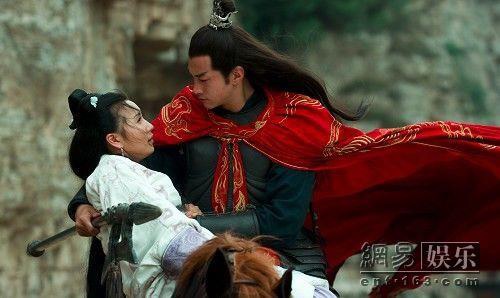
Later on, when the court run to Chang’an, Lü Bu saved Diaochan from falling down from the cliff and covered with his red cloak, decorated with Phoenix, which symbolised marriage proposal and defined his fate, as she became the only woman in his life, bringing him sorrow and joy till death did them part. Diaochan naturally fell in love with Lü Bu as well, and he came to Wang Yun house to ask for beauty’s hand. Wang Yun immediately thought of the plan of assassination of Dong Zhuo. He bethrothed Diaochan to Lü Bu, but when he left, asked Diaochan to became part of the plot. Knowing that Dong Zhuo is fond of beautiful women, he wanted to turn two men against each other. Diaochan should become Dong Zhuo concubine, and lie to both men that she loves each. Diaochan hesitated first, but in the name of loyalty to her foster father and Han Dynasty then played her role very well.
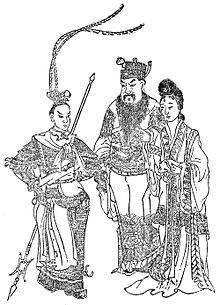
While Dong Zhuo was out one day, Lü Bu sneaked into his bedroom in the hope of seeing Diaochan. Diaochan pretended to be very upset and attempted to suicide by throwing herself into the pond, saying that she is ashamed to see Lü Bu, because she had been violated by Dong Zhuo. Lü Bu became heartbroken and promised, that he will not let her suffer further at the hands of Dong Zhuo. Just then, Dong Zhuo returned and saw them embracing each other. As Lü Bu fled, Dong Zhuo chased him and hurled a spear at him, but missed. Later on, Dong Zhuo met his adviser, Li Ru, who suggested to him to let Lü Bu have Diaochan, to win Lü Bu’s trust back. The woman cannot be more important than foster son and father relationship. Dong Zhuo went back to Diaochan and accused her of betraying his love, saying that he intends to present her to Lü Bu. Diaochan replied indignantly that Lü Bu embraced her against her will and attempted suicide to “prove her love” for Dong Zhuo. Dong Zhuo was moved and dismissed the idea of giving her away. Lü Bu was outraged and went to Wang Yun’s house to express his frustration. Wang Yun then used the opportunity to ask Lü Bu to join the plot to kill Dong Zhuo. As a result of this successful persuasion, Lü Bu assassinated Dong Zhuo when the latter showed up at a ceremony for Emperor Xian to abdicate the throne to him. The ceremony of course, was a trap set by Wang Yun and Lü Bu.
When Dong Zhuo was killed and her mission completed, according to legends she finally married Lü Bu and stayed by his side up until his defeat in battle of Xiapi. As Romance of Three Kingdoms says, Lü Bu refused to follow the advice to go outside the city in order to rearrange the defense systems, because Diaochan was ill and he wanted to stay by her side. That cost him his life, as after the battle by joint forces of Liu Bei and Cao Cao, the latter executed treacherous general, who betrayed his previous masters to have the best horse and the most beautiful woman, despite the fact that Lü Bu was strongest among the warriors. Diaochan wanted to die together with her husband, but was drawn away by Cao Cao followers.
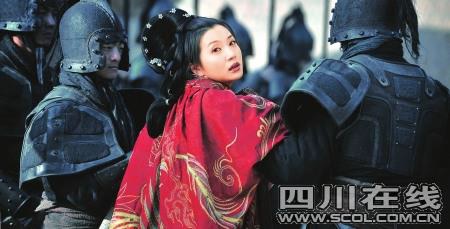
From that point versions of Diaochan fate vary. According to Romance of Three Kingdoms, Cao Cao, who was fond of other men’s wifes, took her to his rooms, but she killed herself with Seven Stars Dagger, given to Cao Cao by her foster father thus ending the circle. The other legend says Cao Cao gave her as a gift to Guan Yu, wishing to win his trust and lure to his side. But Guan Yu suspected treason, remembering how she tricked Dong Zhuo and therefore killed Diaochan. Third version say Liu Bei, Guan Yu and Zhang Fei all wanted to marry Diaochan, so beautiful and seductive she was, arguing bitterly over the issue, and Guan Yu beheaded her in order to end quarrel. In any case, Diaochan at the end remained faithful to Lü Bu and has not outlived him for long, therefore the scene depicting her in his red Phoenix cloak is very powerful as she remained his faithful wife and his only woman.
In modern culture, Diaochan appears a playable character in Koei’s Dynasty Warriors and Warriors Orochi video game series. She also appears in the manga series Souten Kouro. In the card game Magic: The Gathering, there is a Legendary Creature card called “Diaochan, Artful Beauty”. In cinema, notable actresses who have portrayed Diaochan in films and television series include: Violet Koo in Diao Chan (1938); Lin Dai in Diao Chan (1958); Nina Li in The Beauty Diu Sim (1987); Chen Hong in Romance of the Three Kingdoms (1994); Irene Chiu in Guan Gong (1996); Chen Hao in Three Kingdoms TV Series (2010); Gulnazar in God of War, Zhao Yun (2016) and Dynasty Warriors (2019).
FAMOUS HISTORICAL SPOTS IN CHINA, associated with Diaochan:
Luoyang (洛阳): Guanlin temple (关林庙), where the head of Guan Yu, who allegedly killed Diaochan is some legends, is buried.
Xi’an (西安):Han Dynasty Chang’an Weiyang Palace Ruins (汉长安城未央宫遗地), where intrigue involving Dong Zhuo, Lü Bu and Diaochan took place.
Chengdu (成都):Wuhou Temple (武侯祠博物馆),where Liu Bei is buried, one of three sworn brothers who was fighting for Diaochan according to one of the stories.
Helena Avdjukevica
 Walk with the Dragon