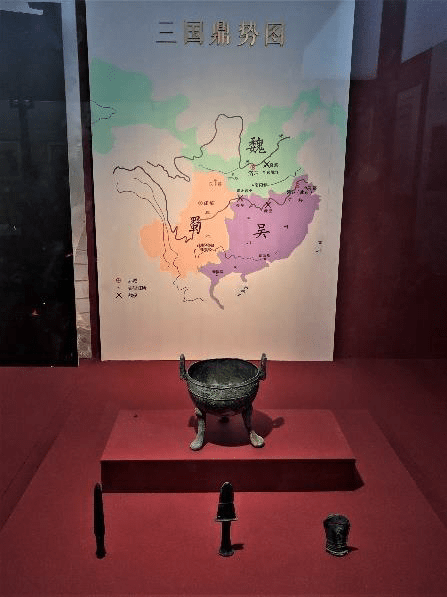
One of the most renowned, romanticised and idealised chapters of Chinese history by all means is Three Kingdoms (三国 ) period. Despite the short term of its existance (officially from 220 to 265 A.D.), it has produced enormous amount of outstanding characters, both men and women and grounds for later development in art, poetry and writing works and painting masterpieces. Therefore the influence of this period on later Chinese, Japanese and Korean cultural heritage cannot be underestimated.
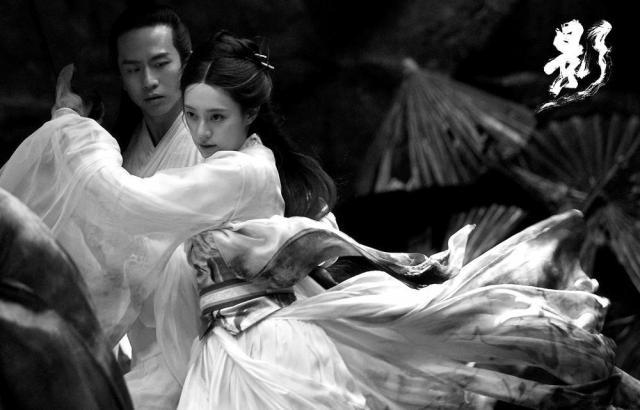
It is quite remarkable, that the whole Chinese cinema industry, which is now number one in the world, surpassing Hollywood and Bollywood, actually emerged from depicting the event of Three Kingdoms. The first Chinese movie, produced in 1905 on Beijing Fengtai Photography, was actually filming of Chinese opera “Battle of Dingjunshan” 定军山之 战 , taking as a base the episode from Romance of Three Kingdoms, where Cao Cao general commander Xiahou Yuan has been defeated and killed by Liu Bei general commander Huang Zhong. The only copy of this historic masterpiece has been destroyed by fire in late 1940s. In year 2000, there has been made China – United States fictional movie “Shadow Magic”, telling the story about the events prior to creation of “Battle of Dingjunshan”.
From historical perspective, the story of Three Kingdoms starts in late Eastern Han period, when empire was weakened during the reign of Emperor Ling, who, as many of the other unsuccessful emperors, was not interested in state affairs, indulging into decadent lifestyle with wine and women. Corrupt eunuch officials imposed huge tax burden on peasants, and as a result, Yellow Turban Rebellion broke out in 183-184 A.D. Rebellion has been quite quickly oppressed by powerful general and Emperess He elder half brother He Jin. As a result of this successful campaign, his power in the court has grown, and when Emperor Ling died in 189 A.D., He installed Emperor Shao, remaining as regent together with his sister. Eunuchs were not satisfied, and assassinated He Jin. In revenge, He Jin subordinates, including Dong Zhuo, sized the palace, killed all eunuchs, deposed Emperor Shao and installed his younger brother as Emperor Xian. This deposition, as well as Dong Zhuo dictatotorship caused the series of civil wars, involving the whole country, that lasted for almost a century.
Out of all powerful warlords, during the course of endless battles, three leaders emerged to found Three Kingdoms. Cao Cao (曹 操 poet and strategist, who seized Emperor Xian and ruled in his name first from his hometown in Xuchang and later from restored capital Luoyang. He, however, did not proclaim himself as an Emperor, despite the great opportunity to do so. But his son, Cao Pi, overthrew Han, founding Kingdom of Wei (魏 ) and sending his own sister (who was Empress) to death together with the last Han Dynasty ruler in 220, starting the official count of Three Kingdoms. Hearing these news, Liu Bei (劉 備) announced himself as Emperor of Shu Han (蜀 漢 and Sun Quan (孫權 ) became Emperor of Eastern Wu (东 吳 )).
This time produced number of warriors, rulers and wizards, who were portrayed in different folk tales and divinated as gods in numerous temples. My favourites are Han Shu Kingdom founders: Liu Bei, Guan Yu (關羽) and Zhang Fei, who gave ethernal brotherhood oath under the peach tree that although they were not born on same year, same month, same day, same hour, but they will die on the same day, same hour. And Zhuge Liang (諸葛亮諸葛亮), most clever of all Three Kingdoms military advisors, surpassing Cao Cao and Sima Yi of Wei Kingdom and Zhou Yu of Eastern Wu Kingdom. All those heroes are divinated up until now. In Chengdu Wuhou Temple stories of they lives are vividly depicted and the people still coming secretly asking for advices from Zhuge Liang, admiring faithful friendship of Liu Bei, Guan Yu and Zhang Fei and courage of Zhao Yun.

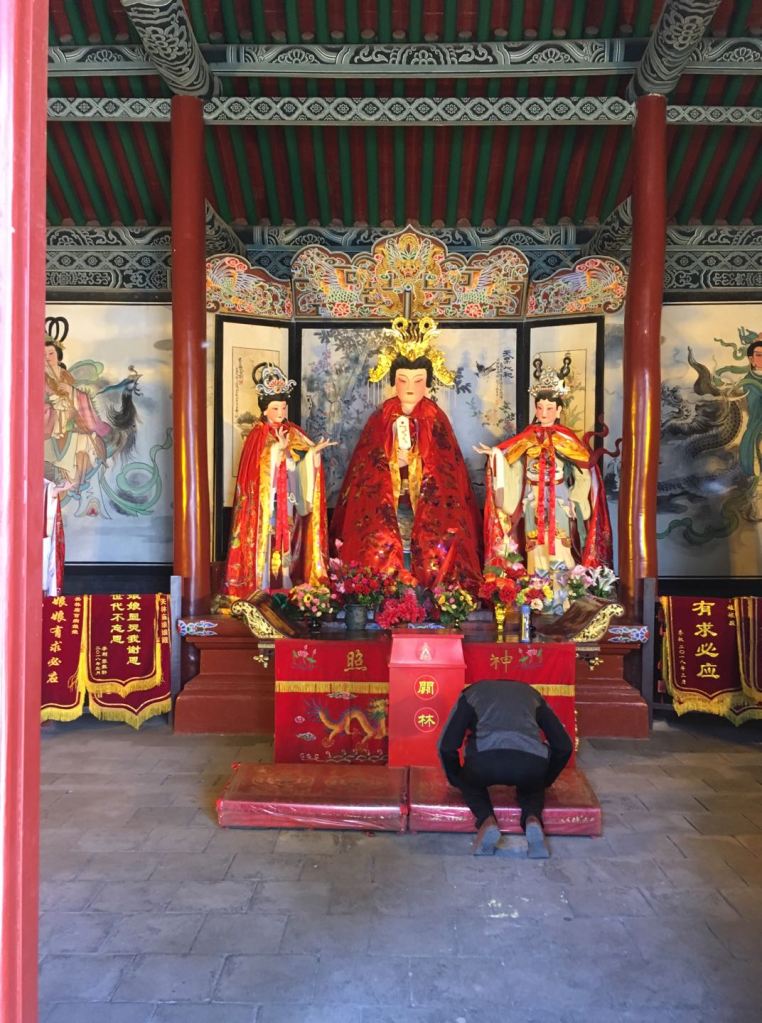
Interesting is fate of Guan Yu, who grew from military commander and strongest general into God of Wealth after his death. Sun Quan, ruler of Eastern Wu Kingdom, killed Guan Yu and sent his head to Cao Cao, trying to blame him for famous general and sworn brother of Liu Bei death. But Cao Cao, who admired and loved Guan Yu himself and tried many times to persuade him to come to his side, ordered to make Guan Yu body from precious wood and buried his head with emperor’s honours, later on founding Guanlin Temple in Luoyang. Guan Yu then become one of Cai Shen embodiments, deified as early as the Sui dynasty (581–618), and is still worshipped today as a bodhisattva in Buddhist tradition and as a guardian deity in Chinese folk religion and Taoism. He is also Guardian God of both Police and Mafia, the only way to distinguish whom he is protecting is in which hand he is holding his armour.
All those very masculine heroes are portrayed very well in various masterpieces, books and movies and first come to mind, when speaking of Three Kingdoms. But they represent rather Yang (阳 ) forces according to Feng Shui teaching, most well known, most obvious and most dynamic. In my work I will concentrate more on Yin (阴 ) power, which remain behind the scenes and look at the faith of women in this remarkable historical period. It is very interesting coincidence, that Zhang Yimou 2018 movie Ying(影 ) actually depicted in artistic and indirect way the very end of Three Kingdoms period, right before Jin Dynasty was proclaimed by Sima Yan on 8 February 266, when China was united again.
One of the European Medieval fairy tales says that King Arthur has been imprisoned by the neighboring King, and in return for his freedom he had to answer the question: “What does any woman really want, above all?”. He unsuccessfully seeked for an answer for a year, inquiring all wisards of all lands, until the old witch granted him correct response: “Is to be in charge for her own life”. Three Kingdoms stories are in a way is very similar to European Medieval tales about King Arthur and Knights of the Round table, where knights are brave, strong, skilled in armor, constantly challenging each other in battles, but ladies are subtle and beautiful, calling for the protection and deeds in the name of love and sometimes giving a valuable advice. But the answer granted by the old witch was not applicable to any of the woman of that time. This is the very essence of romantic novels, calling for the most traditional values, weak women unable to decide their fate other than committing suicide and strong men in charge of everything. Although these sentiments sound very appealing to some men and some women, we should remember that this kind of extremes are possible in the times of war, chaos, poverty and insecurity.
I was very puzzled why this is so, and one of the hypothesis is that such time call for brutal force of extreme masculinity. Wins the one with bigger armour, stronger hands, faster horse and higher battle spirit. In this kind of society, when men are so brutal, women ought to outweight them with beauty and weakness, in order to keep the overall balance. The beauty was set as a trap for men, who were ready to kill each other to gain woman as a prize, kill the beauty to keep brotherhood, or sell their own sister to the enemy to keep peace without recognizing women as human beings.
But during the time of peace and stability, taking as historical example Tang Dynasty, Ying power comes forward, bringing prosperity, good communication, trade, negotiation skills, highly skilled crafts, luxury and fine arts. There is no need to go to battle every day, therefore men develop feminine qualities in order to be successful, and on the contrary, women develop masculine qualities in order to keep the balance and develop more subtle parts of social life. It does not mean men are better than women or women are better than men, it just shows the tendency and calls for recognition of necessity for further development.
Men and masculine Yang qualities are more useful in the times of war and poverty, and women and respective feminine Yin qualities are more useful in the time of peace and prosperity.
Helena Avdjukevica
 Walk with the Dragon