Famous poetess and remarkably strong woman was born ca. 177 A.D. in Kaifeng 开封, Chengliuyu county, Henan Province 河南省, during the reign of emperor Lingdi. Her father, Cai Yong (known as Cai Bojie as well), was government official at Eastern Han court, supervising corruption elimination bureau. Naturally, this kind of position made him exposed to the false accusations, when he himself made enemy of Liu He, high court official. Cai Yong has been found guilty and went to a prison, and later sent to excile, when Cai Wenji was only one year old. Nine month later, he was granted a pardon by Emperor Han Lin and summoned back to Luoyang. But faith was against him, as he offended Wang Zhi, the regional governor. Fearing of being imprisoned again, Cai Bojie went with his family to South East regions of Wujun and Huji (nowadays Jiangsu and Zhejiang provinces), where lived for subsequent twelwe years.
The court was thrown in turmoil folllowing death of Han Ling Emperor in 189. Later this year, one of the powerful warlords, Dong Zhuo, seized the power in the court and installed Emperor Shao. In order to strenghten his power, he recalled some exciled officials back. This way Cai family returned to Luoyang and later followed the court to Chang’an, when Luoyang was burnt down and ransacked by rebellions. Cai Yong was appointed as court historian in the imperial library and while in this post, wrote Xu Han Shu (Chronicles of Han Dynasty), becoming an authority of Han history. He was also a renowned musician and poet.
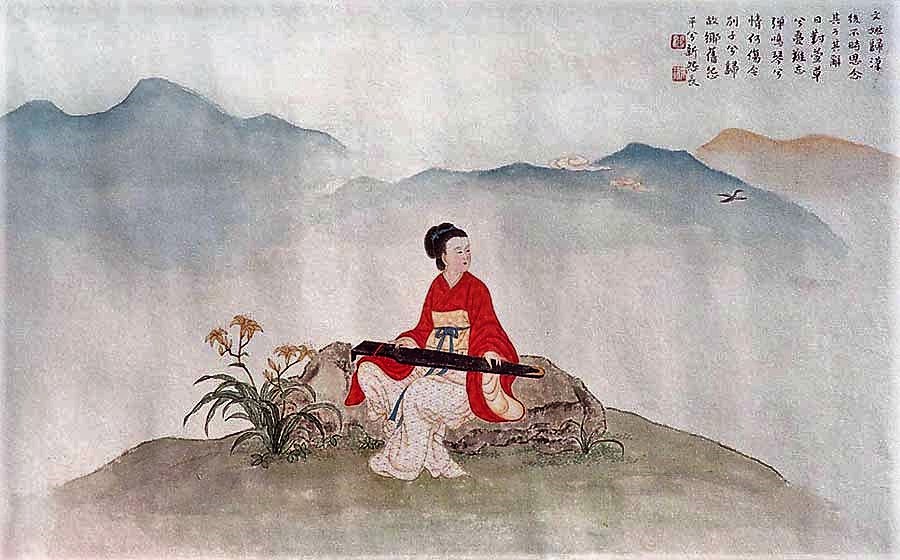
Cai Wenji grew a very talented in music and literature, as well as had exceptional memory. Legend says that when she was six years old, her father played guqing and he occasionally broke one of the strings. The girl said without looking at the instrument, that it was the second string. Then Cai Yong, wishing to test his daughter, deliberately broke another string. And again, she said correctly that it was the fourth string. Since that time, Cai Yong started to teach his daughter himself, developing her talents in all areas of art and literature. Later on, under his tutoring she became an expert on ancient Chinese classical music, gifted poet and calligrapher, as well as skilled speaker, unafraid to show her wit and wisdom in front of the others.
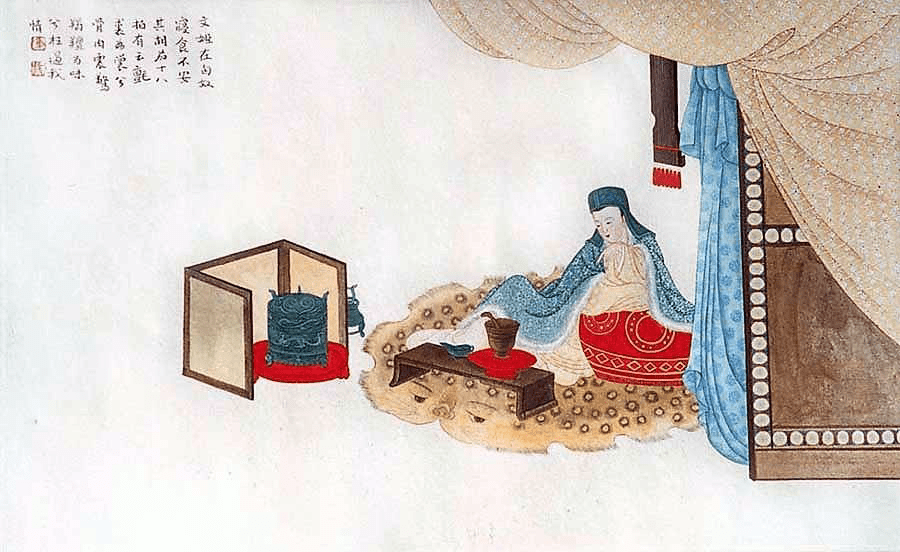
When her family moved to Chang’an Cai Wenji was 15 years old. Later that year she married to Wei Zhongdao , who died two years later without leaving the children. That year her father died in prison after the unsuccessful court coupe. Dong Zhuo was killed later in 195 and as a result of power struggle parts of Northern China were overrun by the xiongnu horsemen. They ransacked Chang’an and the villages, taking slaves, burning down hoses and killing lots of civilians. Later on, poetess described it in the famous work “Eighteen Laments”. Cai Wenji was taken to the north and presented as a gift to xiongnu tribal chieftan Liu Bao (Zuoxian). He fell in love with educated and beautiful young woman, married her and they had two children.
She lived at with her second husband for twelve years, but never accustomed fully to nomadic traditions. Although he loved her very much, she always was looking to the South, longing for her home country. One of her most renowned poems is dedicated to that:
《悲憤詩》
Poem of Sorrow and Anger
處所多霜雪,胡風春夏起。
My dwelling is often covered by frost and snow, The foreign winds bring again spring and summer;
翩翩吹我衣,蕭蕭入我耳。
They gently blow into my robes, And chillingly shrill into my ear;
感時念父母,哀嘆無窮已。
Emotions stirred, I think of my parents, Whilst I draw a long sigh of endless sorrows.
有客從外來,聞之常歡喜。
Whenever guests visit from afar, I would often make joy of their tidings;
迎問其消息,輒復非鄉里。
I lost no time in throwing eager questions, Only to find that the guests were not from my hometown.
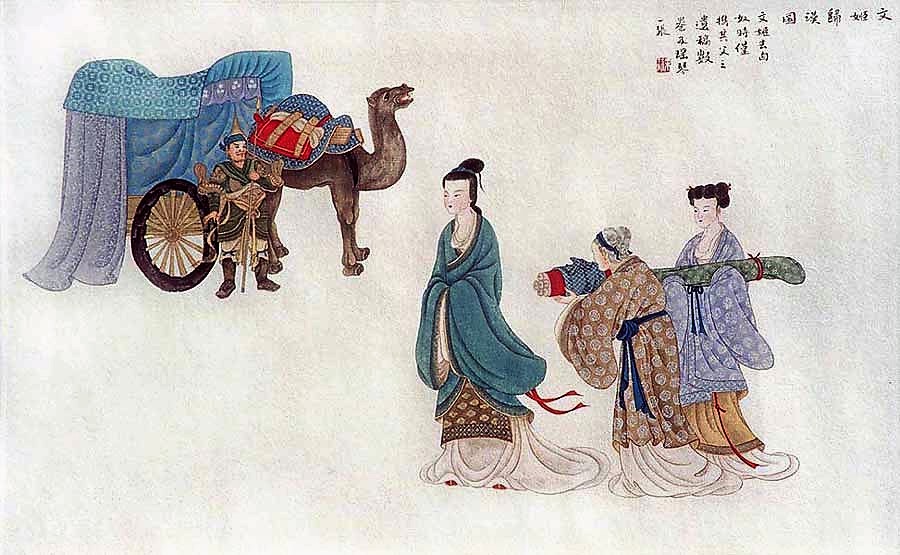
Twelve years later member of her clan, powerful warlord Cao Cao 曹操 took highest position in the Han court, and learned about Cai Wenji fate. Partly as paying tribute to her father, partly because she was one of a very few his clan members to survive, Cao Cao paid a very handsome amount of money and various goods to Liu Bao in order to bring Cai Yang back to her homeland. Liu Bao was very reluctant, but let his wife go, fearing of Cao Cao anger. But according to xiongnu customs, children had to stay with their father. This story later on has been depicted in numerous works of art, as well as in opera and poetry, “Cai Wenji Returns to Her Homeland”, since Tang Dynasty. As a desperate mother she wrote the following verse:
“My nomad children wail till they lose their voices—alas! Who could have known
That while we still lived there would come a time that would separate us like death?
My longing for my children makes the sun lose its light,
Where can I find wings to carry me back to you?”
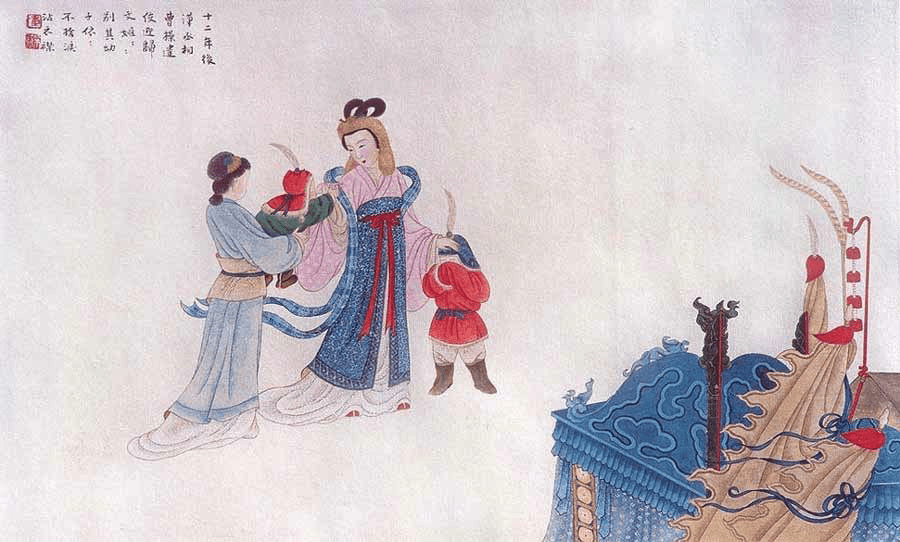
Nevertheless, she was happy to come home and worked very hard in imperial library to restore her father’s legacy. It is said that she recomposed at least 400 out of 4000 his works, as well as wrote her own poetry. It was vividly based on her own life story rather than on academic and traditional grounds. After she experienced so much sorrow, she was still able to enjoy the life, which has been depicted in her poem “I See My Blooming Years Again”. After her xiongnu husband death, she reunited with her children, they came from the north with a special escort.
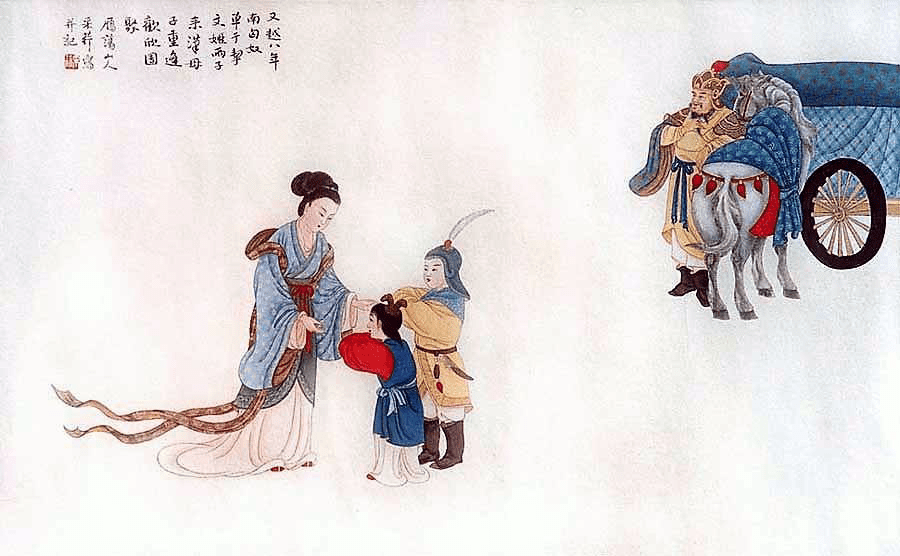
Upon her arrival, Cao Cao arranged for her marriage with county magistrate Dong Si. Who also loved her very much. That was a very happy marriage. But on one occasion he had misfortune to offend Cao Cao and therefore was condemned to death. Legend says, that Cai Wenji came to the court barefooted with loose hair, when Cao Cao was having dinner with court officials and boldly asked him, if he is going to give her another husband, in order to please her so that she can complete her work. Cao Cao then changed his mind, sent swift horsemen to stop execution and later on pardoned Dong Si. Grateful Cai Wenji wrote from memory hundreds of articles that she could recall from times spent in the library with her father.
In modern culture, Cai Wenji appears in Guo Moruo play on her life in 1959. In 1976, a crater on Mercury was named Ts’ai Wen-chi after Cai Wenji, citing her as “Chinese poet and composer”. In 1994, a crater on Venus was named Caiwenji after Cai Wenji, citing her as “Chinese poet”. Also, Cai Wenji appears as a playable character in Koei’s Dynasty Warriors: Strikeforce 2 and Dynasty Warriors 7 (her debut as a playable character in North American and European ports). She also appears in Koei’s Romance of the Three Kingdoms video game series and in Dynasty Warriors 6: Empires as a non-playable character. She is also a playable character in Warriors Orochi 3.
Helena Avdjukevica
In the article used paintings of Zhang Cuiying “Wenji Returns to Han” http://www.pureinsight.org/node/1818
 Walk with the Dragon