
It is hard to imagine that in a small gully in Qionglai, about two hours drive from Chengdu, there are amazing cliff stone carvings of the Tang Dynasty, which are 1100-1200 years old.
Buddhism was introduced into China along the ancient Silk Road from India, leaving many exquisite grotto statues along the way, from Kizil Grottoes in Xinjiang to Mogao Grottoes in Dunhuang, Yulin grottoes, Yungang Grottoes in Datong and Longmen Grottoes in Luoyang. After the An Lushan 安史 rebellion (755-763 AD), the course of Tang Dynasty changed from prosperity to decline, the economic centre moved South, and there were no large-scale grotto statues in the Central Plains. At this time, Buddhist grotto art entered Sichuan from Jinniu Road, and lotus blossomed in Minjiang River, Jialing River, Fujiang River, Tuojiang River, Qingyi River and other river basins, leaving a lot of grotto sites, such as Guangyuan, Jiajiang, Leshan. The stone carvings of Anyue and Dazu in the Song Dynasty reached the peak of Chinese Grotto Art.
Historically, the spread of stone carvings and grottoes is often related to transportation. For example, Dunhuang Grottoes are to the Northern Silk Road, Guangyuan thousand Buddha cliff has been built on Jinniu (Golden Bull) Road, Bazhong Nankan Cliff Statues are on Rice Warehouse Road, and Qionglai is the hub of the Southern Silk Road. The southern silk road starts from Chengdu and enters Yunnan through Qionglai, Ya’an, Yingjing, Xichang, Dechang and Huili, which is known as the first city on the Southern Silk Road. Qionglai has been rich in salt, iron, wine, tea and porcelain since ancient times, which has attracted merchants from all parts of the Tang Empire. The people were rich and had the financial resources to carry out statue carving. That’s how Qionglai has become the most important grotto centre in Chengdu Plain.
Huazhi Temple (花置寺)
Huazhi temple is located in Huashi mountain, 7 kilometres northwest of Qionglai city. The exquisite stone Buddha statues were built near the temple during the Tang Dynasty. Although they have experienced great changes for more than 1200 years, luckily, some of them have survived.
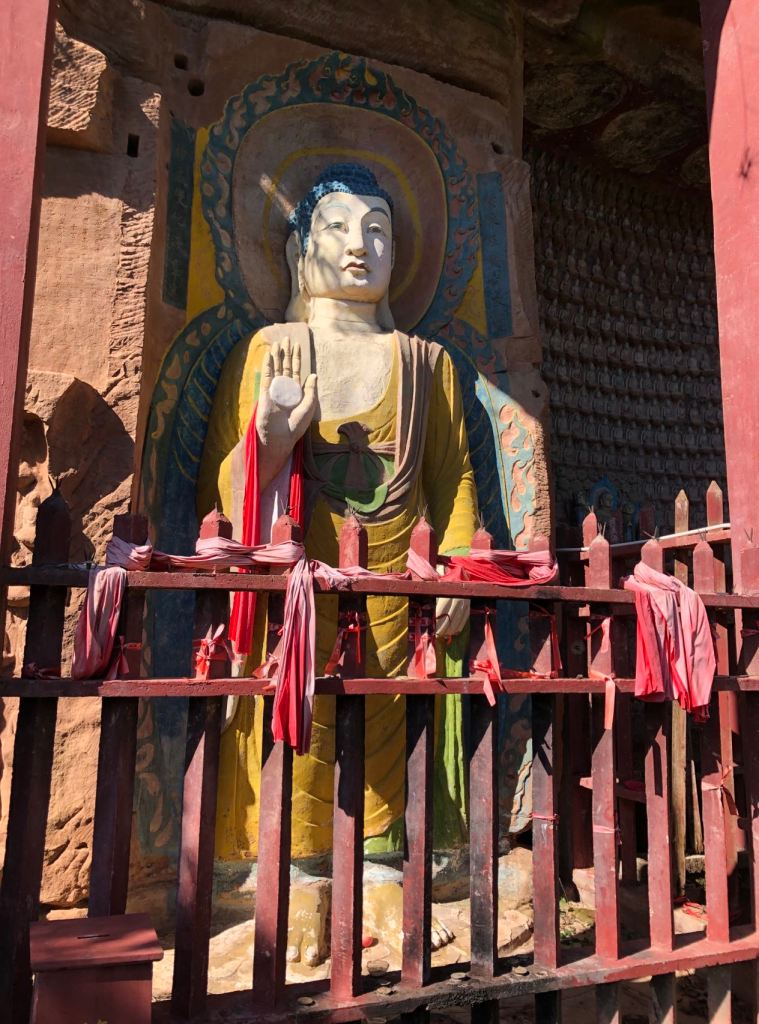
There are 1106 inscriptions on the statue stele of the temple, which were written by Ma Yu, the imperial envoy of the front hall of Yi Lang in the 14th year of the Zhenyuan period of the Tang Dynasty. It is recorded that this statue was made by the monk Ma Cai 马采 of Chang’an Zhangjing temple. In the fourth year of Dali (AD 769), after Emperor Li Yu of the Tang dynasty built the Zhangjing temple in Chang’an, he was granted by the emperor to be a master of Exemplary Morals 以德 and to “lecture on the outline of virtue” in the temple. Therefore, the monk adopted the “habit of going to the country and valuing the capital of God”. In the imperial period of Zhenyuan, he took the will of the Tang Dynasty, crossed the Sichuan Road of the Qin pass and cooperated with officials of the southwest Jiezhen town to chisel Buddhist statues in Qionglai to promote Buddhism. The statue stele of Huazhi temple is a rare material for the study of Qionglai’s Buddhist history and statue age.
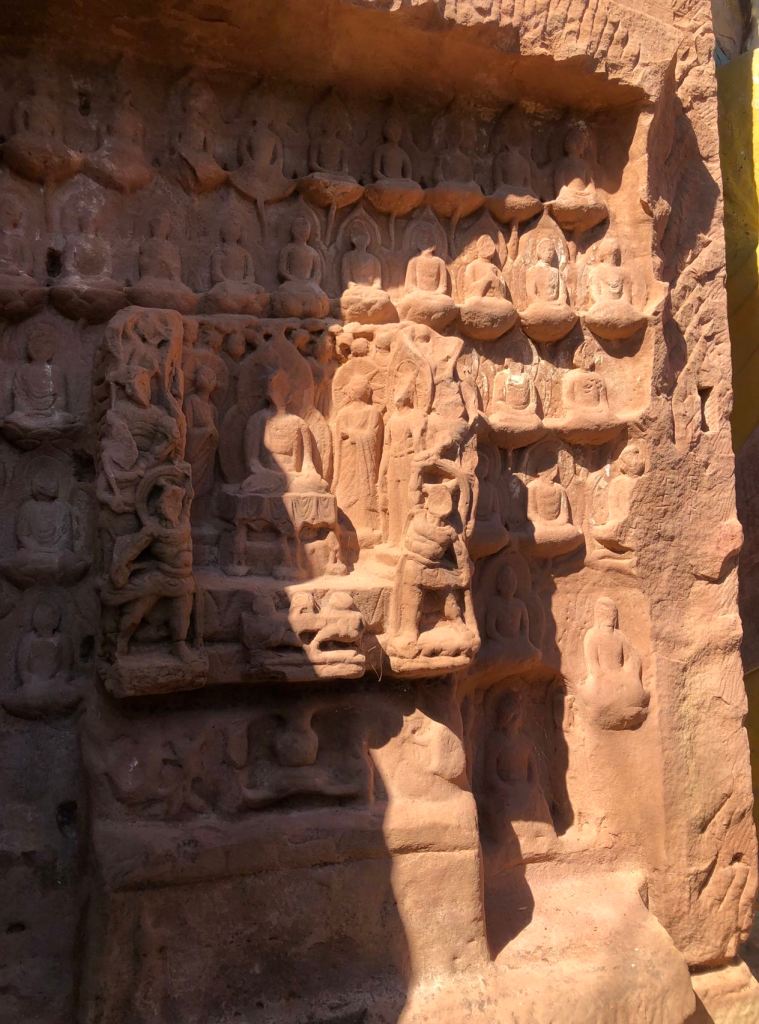
The statues are located in the centre of Zhuxi 竹溪湖 lake reservoir. It was first built in the 14th year of the Zhenyuan era of the Tang Dynasty (798). There are 7 nishes in total, with a total length of 38 meters. The largest is a statue of Buddha, 4.2 meters high. The other two nishes are thousand Buddha niches, which are two groups of huge relief small Buddhas. There are 21 rows of small Buddhas in the right niche, 45 in each row, totalling 945 small Buddhas; There are 20 rows of niches on the left, 40 in each row, and 800 small Buddhas. There are 1745 small Buddhas in the two niches.
It is composed of many Buddhist statues, with simple clothes and smooth lines; The layout is rigorous and the sabre technique is powerful and mellow, which fully reflects the traditional sculpture style of the Northern Wei Dynasty and the prosperous Tang Dynasty.
Pantuo Temple (磐陀寺)
Pantuo temple is located in Pantuo village, 5km west of Qionglai City, Chengdu. It is named so because in the centre there is a big stone rock 磐 (pan). From the Tang Dynasty (618-902) to the Qing Dynasty, it was a famous Buddhist resort.
Temple History
Founded in 820 A.D. (the 15th year of Yuanhe reign of emperor Xianzong of the Tang Dynasty), Pantuo temple was originally named Kaiyuan 开元 Temple and changed its name to Pantuo Temple in the Ming Dynasty, because the temple has big rocks like a huge stones Pan 磐. It has a history of 1200 years. It was rebuilt in the 25th year of Hongwu’s reign of the Ming Dynasty (1392).
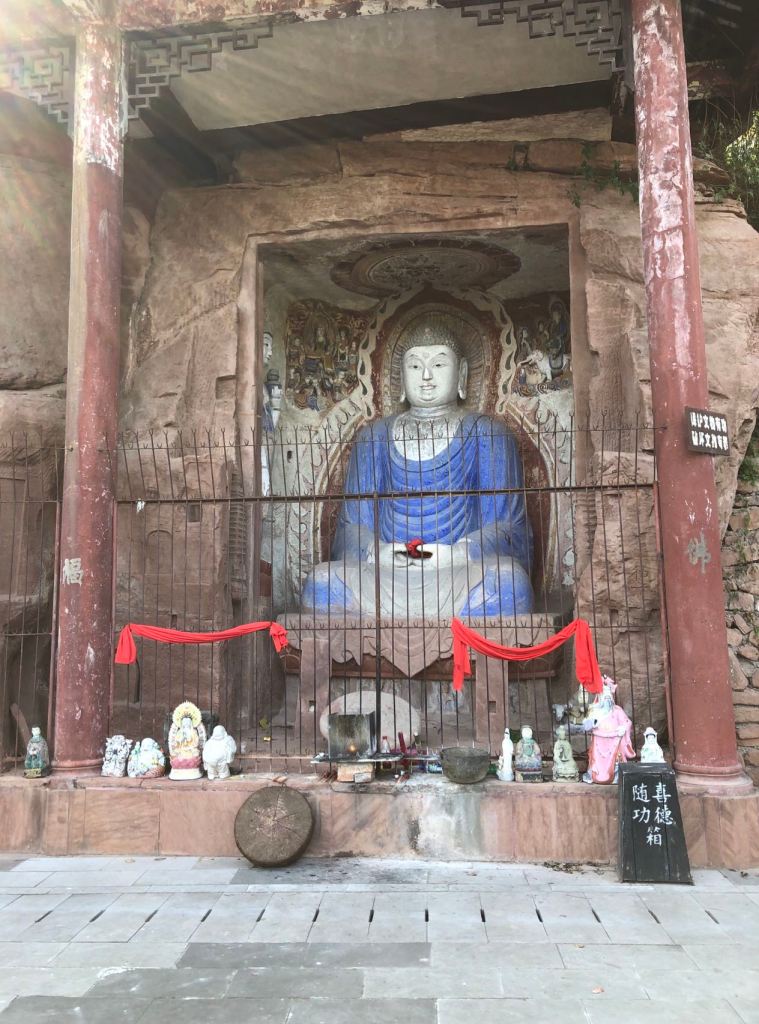
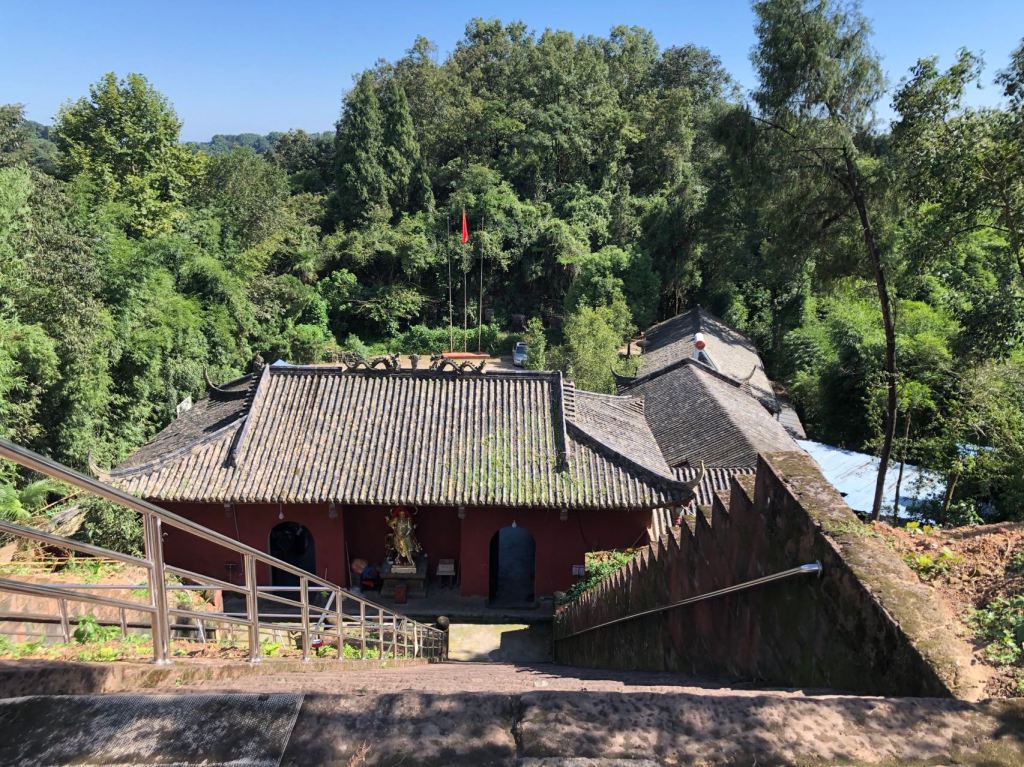
The temple stands against the mountain, lying from west to east, covering an area of more than 20 mu. With the vicissitudes of time and the rise and fall of governments, after the liberation, the monasteries have been abandoned and the monks have disappeared. After the cultural revolution, only one Ming Dynasty Hall, three statues of Great Buddha, 53 ginseng murals and cliff statues in several niches around the hall remained in the Pantuo temple.
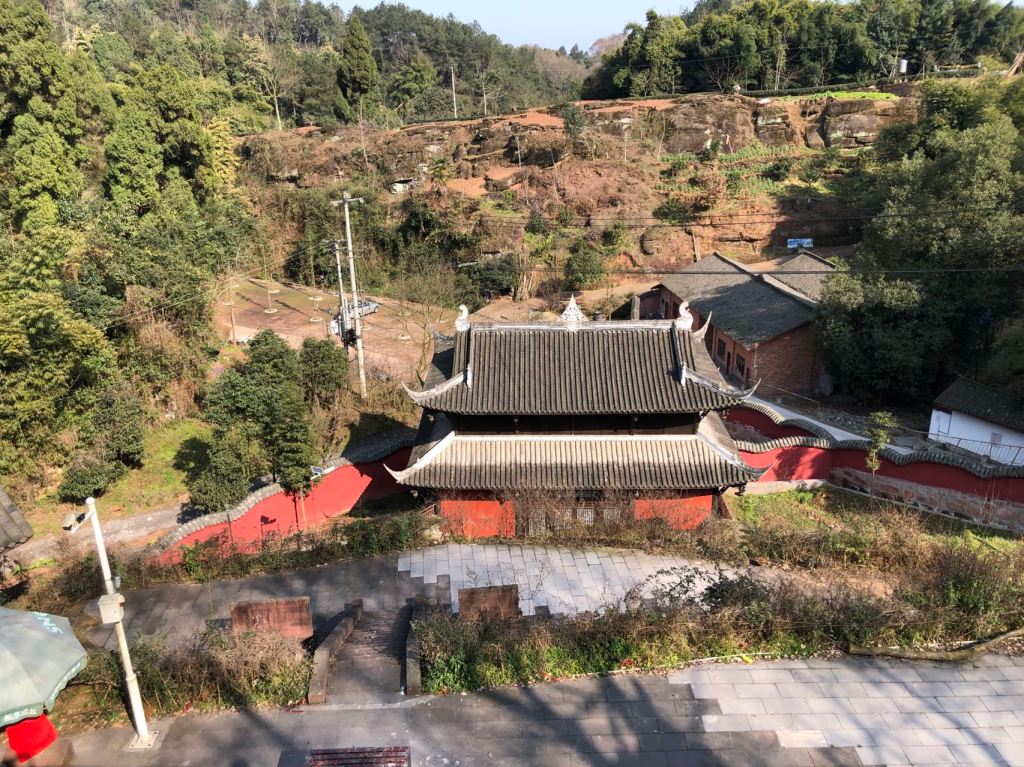
In July 1985, the Chengdu municipal government listed the Pantuo temple as a municipal cultural relics protection unit. In 1989, the roof of the main hall was repaired and protected. In 1995, Mr Wang Zemin, a private entrepreneur, donated 2 million yuan to personally supervise the construction. It took three years to rebuild the Mahavira Hall, the Guanyin Hall and the three holy halls on the old site, build canteens, and houses, improve water and electricity facilities, and invite craftsmen to reshape the Buddha body. The Pantuo temple was able to reproduce its vitality.
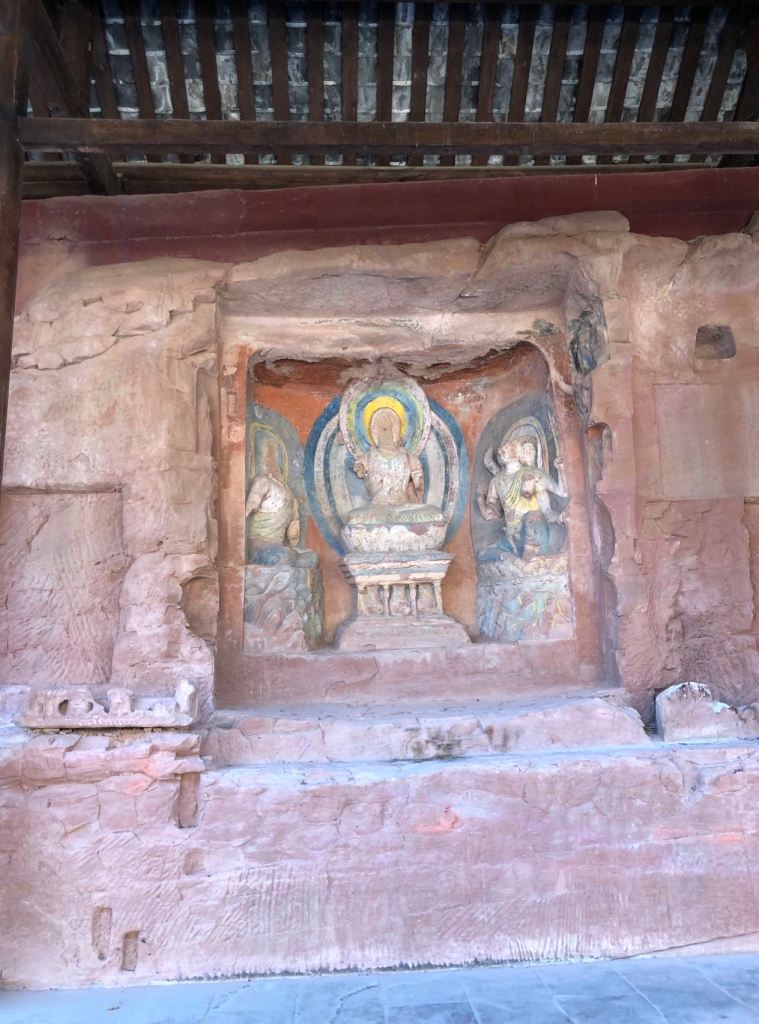
In order to strengthen the protection of the temple’s cultural relics, in 1995, an imitation wooden rainproof shed was built for the cliff statues in the temple. In 2001, the temple wall was built, and closed walls were built on both sides of the hall. The original walls were reinforced, and the murals in the hall were repaired and protected. In May 2006, the cliff statues of Pantuo temple, together with those of Shisun 石笋山 (Stalagmite) Mountain in Datong Township and Huazhi 花置寺 temple, were collectively called Qionglai grottoes 邛崃石窟 and were listed as the Sixth Batch of national key cultural relics protection units. The Mahavira Hall was built later.
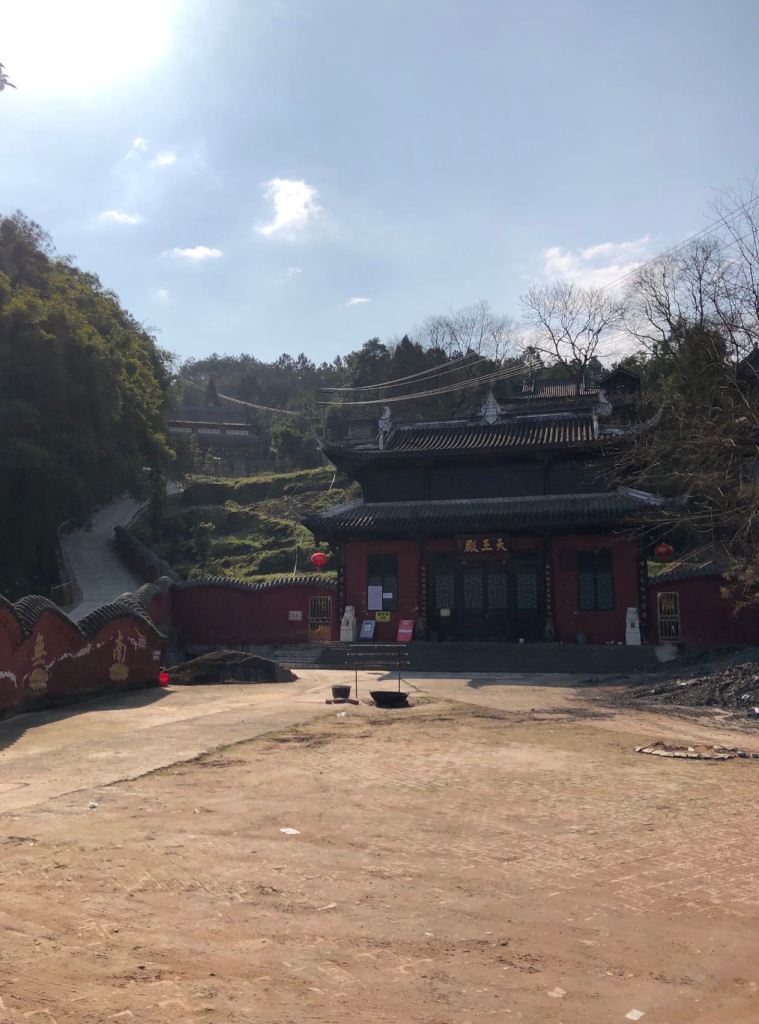
During the Wenchuan earthquake in 2008, the cultural relics of the Pantuo temple were seriously damaged. In 2010, the relevant departments carried out rescue restoration and maintenance on the cliff statues, the main hall, clay sculptures and murals of the Pantuo temple, and strengthened the protection of rainproof and drainage. At the same time, they built a new gate, middle gate, pavilion and management room, and strengthened the environmental renovation of the whole temple. This Guanyin Hall should have been newly built later.
I wonder if this huge stone bag in front of the temple the rock-like one in those days is. The word “Pang stone” carved on it may mean that this large stone is the monk Pang in meditation.
There are six existing cliff statues in the Pantuo temple, 1091 of which are stone carvings of the Tang Dynasty. In addition to the “Big Buddha niche”, there are five niches behind the hall of the Ming Dynasty, of which three are well preserved. One is called the thousand Buddha niche, the other is the Western Pure Land change, and the other is the tantric statues.
In July 1985, the people’s Government of Chengdu announced that the Pantuo temple is a municipal cultural relics protection unit.
Cliff statues of Pantuo Temple
The existing Mahavira hall was rebuilt in 1392, the 25th year of Hongwu reign of the Ming Dynasty, and repaired in 1437, the second year of Zhengtong era of the Ming Dynasty. Its shape is a single eave and mountain style, with four columns and three bays in width and the same goes for depth; The plane is square with a side length of 9.95 meters. Under the eaves, there is a bucket arch. In the middle of the hall, there is a clay sculpture of the “three saints of the west” (that is, the “three saints of Amitabha” in Buddhism); Amitabha in the middle, Avalokitesvara on the left, and great momentum on the right. The three images are all sitting on the lotus platform, about 2 meters high.
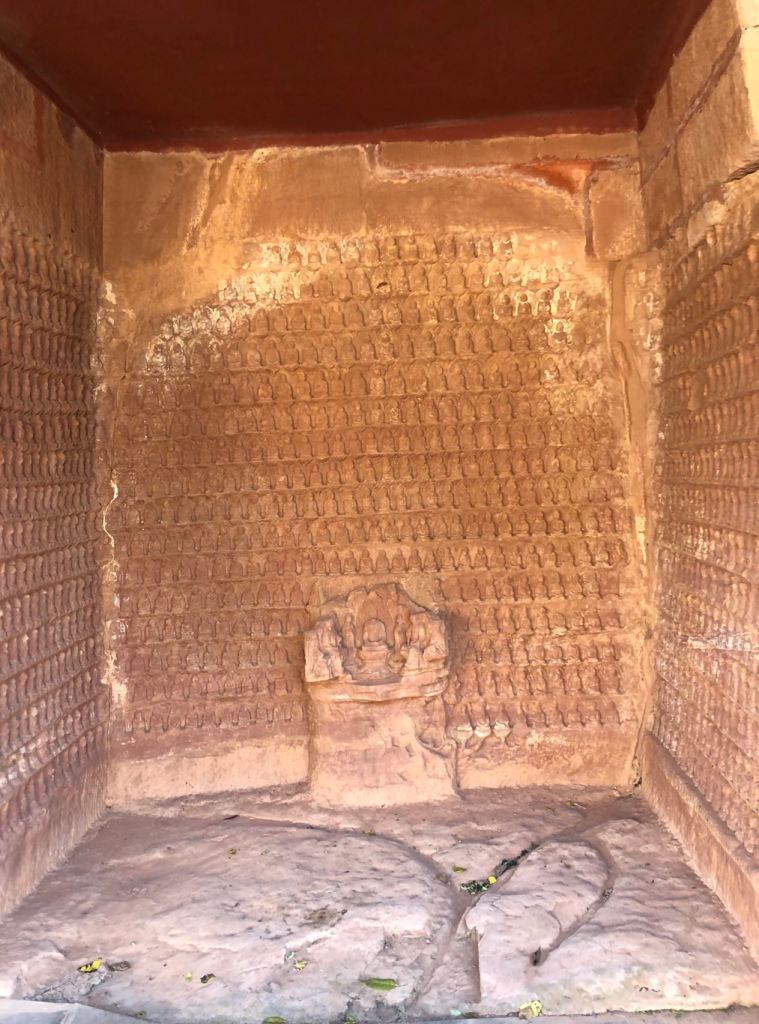
There are murals of the Ming Dynasty (fine brushwork and heavy colour surface) on the four walls of the hall, which is a precious cultural heritage. The content of the murals is a Buddhist story depicting the “fifty-three ginseng of a talented boy”. The stories in the murals are separated by mountains and rivers, trees, flowing clouds, houses and pavilions so that the upper and lower parts are connected and independent of each other. Its strokes are strong and smooth, the colours are gorgeous, the picture structure is strict, and the characters are carefully depicted, which is similar to a precious classical comic strip. There are still four grottoes of cliff statues around the temple. The first cave in front of the temple is the one Buddha and two Bodhisattvas in the 15th year of Yuanhe (820 A.D.). The left and right outer walls are engraved with floating pictures and a group of acrobatic musicians. One of the five Grottoes behind the temple is “Thousand Buddhas”, the other is “pure land change”, and the other grotto is a Tantric statue, also Tang style.
Stalagmite or Shisun Mountain (石笋山) Grottoes
Most of the Qionglai grottoes are square Grottoes with complex compositions, plump statues and dignified faces. The themes are “three saints of Huayan”, “three saints of the west”, “pure land change”, “Guanyin Sutra change” and “Thousand Buddhas”, which are the essence of Sichuan grotto art in the middle and late Tang Dynasty. In 2006, it was listed in the Sixth Batch of national key cultural relics protection sites.
Stalagmite mountain is located in Jinggou village, Datong Township, Qionglai city. The reason why it is called stalagmite mountain is that surrounded by cliffs, there is a solitary peak standing like a bamboo shoot.

Coming from Qionglai City, it is far away from the main road and about an hour’s drive by car. It is almost inaccessible. Who would have thought that more than a thousand years ago, it was an important passage from Chengdu to Lushan, Ya’an, Yunnan and even overseas through Dayi and Qionglai. It is precisely because of this once busy ancient road is possible to see cave statues now.

The cliff statues of Stalagmite Mountain are carved according to the cliff shape. The statue niche is divided into two sections. The north section has one level, and the south section is divided into the upper and lower levels. The north section was excavated slightly earlier than the south section. On the 120 meters long and 40-meter-high cliff, there are 33 niches and more than 700 statues. Among them, the north section is the essence of Stalagmite Mountain. Whether it is a statue of Buddha or a Dharma protector, a warrior, a supporter, etc., the statue is towering and magnificent. It is a pity that the iron door closes the entrance to this part, and the door is rarely open.
This is the most classic cave in the whole stalagmite Mountain Grottoes. It is the most typical and classic statue in Buddhist statues. This cave is larger and well preserved than the others. Therefore, this section of cave statues is locked in the iron gate. Pilujana Buddha sits on the lotus platform, and Ananda with Kasyapa are standing on both sides of the Buddha. On the right side of the six-tooth white elephant is Puxian (or Samantabhadra, the Bodhisattva of practice and meditation), and on the left is Wenshu (or Manjusri, Bodhisattva of Wisdom). Unfortunately, the head of the Buddha is missing. Next to Vairocana 毗卢遮那佛 Buddha is the Heavenly King Vaisravana 毗沙门天. The other statue is about 4 meters high, wearing armour, stepping on the Yasha, with his right hand on his hips and his left hand supporting the pagoda. This is Li Jing, the “Pagoda-Bearing Heavenly King” in the famous ancient novel “Journey to the West”, which has been changed by the people several times.
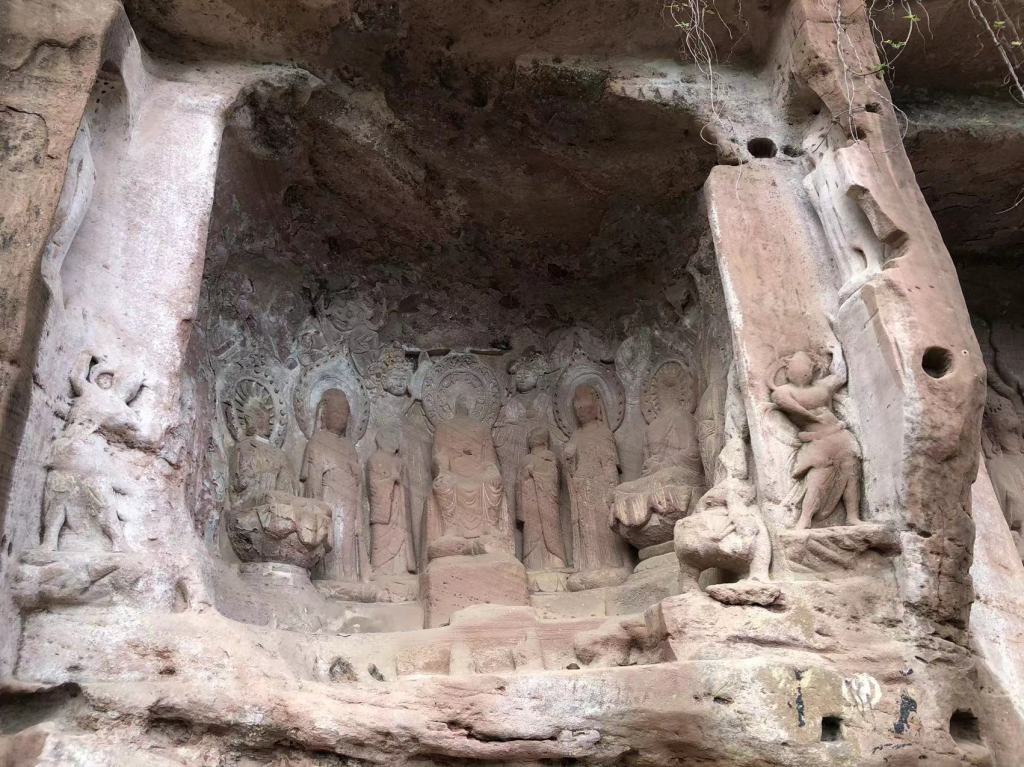
It is said that during the Tianbao period (742-756 A.D.) of Emperor Xuanzong of the Tang Dynasty, the Tubo kingdom sent troops to encircle the Chang’an capital. Emperor Xuanzong of the Tang Dynasty asked monk Bu Kong to set up an altar in the imperial palace. The Chang’an capital guard later sent an envoy to report that the Heavenly King Pishamentian 毗沙门天 (Vaisravana) appeared in the clouds 30 miles northeast of the city. Three or five hundred magic soldiers were wearing gold armour. The earth moved from their heavy steps. At the same time, golden rats bit off the bowstring of the enemy. The Tubo army was defeated without fighting. Because of this legend, the worship of the Pishamentian (Vaisravana) flourished in the Tang Dynasty. He was often regarded as a protective god by the army. Temples were built in the city towers and barracks. Even the military flag of the Tang Dynasty fluttered his powerful image.
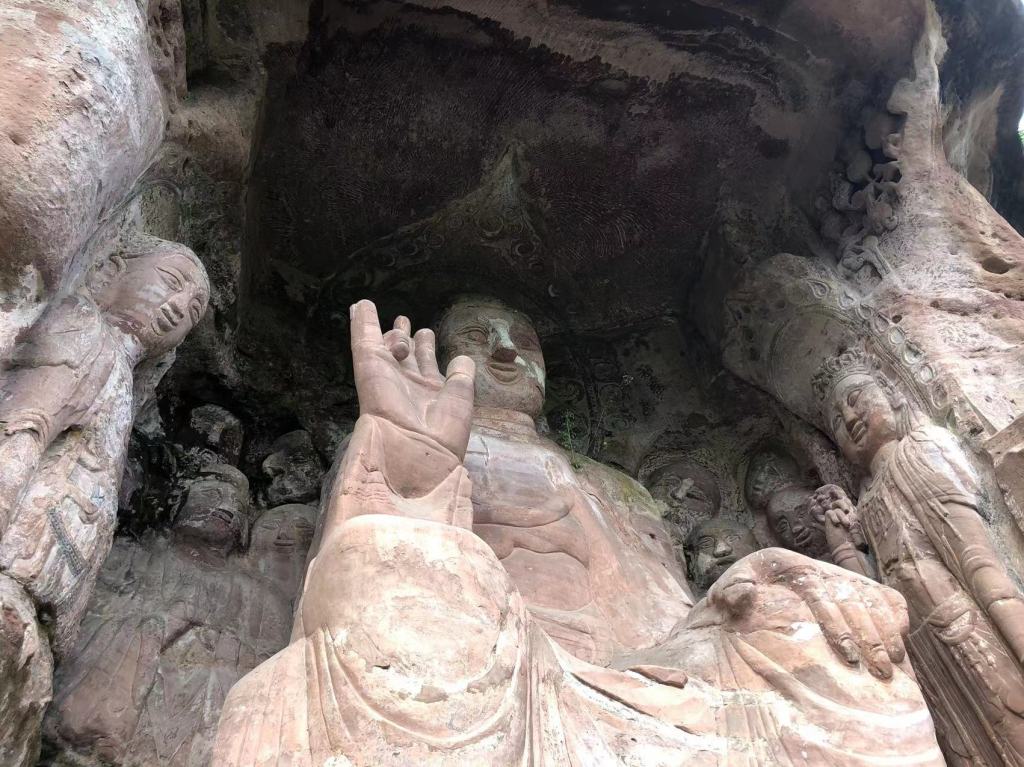
Maitreya Buddha in niche 14, the largest statue in stalagmite mountain, is 7.5 meters high. Two Bodhisattvas are serving on both sides. There are obvious repair marks on the fingers. The artistic shape of this niche is not as beautiful as that one before. It is actually quite primitive. Interesting is the gesture of the right hand, reminding Prithivi mudra. The ring finger represents the Earth element and the planet Sun (Surya) as if the Buddha is giving the blessing to the Earth, with the mild warmth of the Sun.
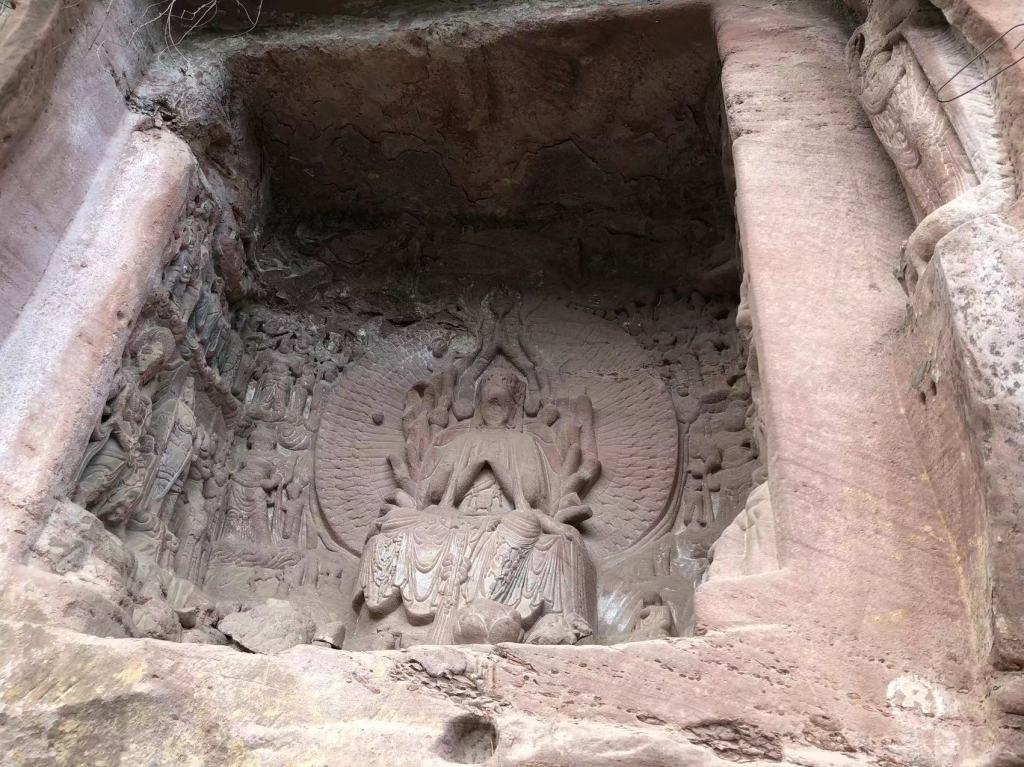
“Thousand hand Avalokitesvara” in cave 8.
There are two female dependents behind the third Buddha in cave 9. In the back, eight heavenly dragons have been weathered and peeled off.
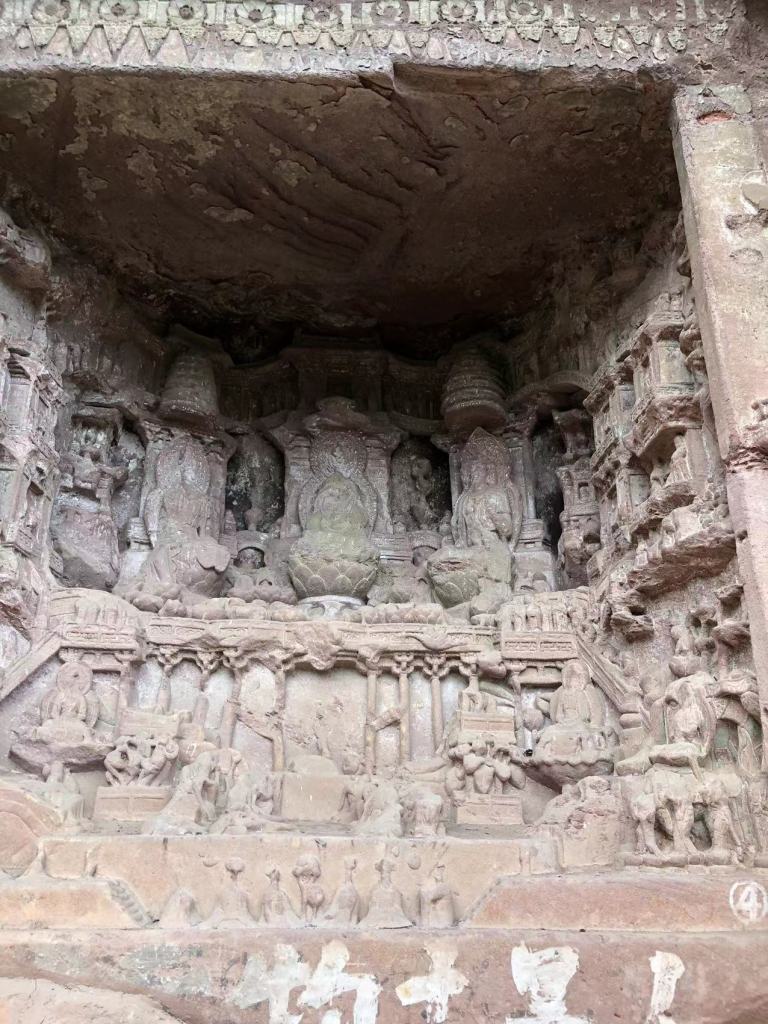
The Western Pure Land Change in cave 4 is a typical niche cave in Shisu Mountain. Amitabha Buddha, Avalokitesvara Bodhisattva and Dashizhi (Mahasthamaprapta)Bodhisattva sit in the centre. Gold, silver, agate and amber are everywhere in the seven-treasure lotus pool; The pagodas, temples, pavilions and towers, double eaves, brackets and railings are clearly visible, connected by cloisters, and many immortals roam on foot or stretch their waists. On both sides of the lower part are carved “boating pictures”. The bow of the boat is high, and the stern is hidden in the bridge hole. Three boatmen are rowing desperately. The first one is pushing his legs upward, the middle one is bowing his waist and burying his head, and the third one is turning his back. The dignitaries on the boat are happy and relaxed; There are also various kinds of musical instruments on both sides, such as gongs, drums and heel flipping. This picture may represent the Western Paradise in the eyes of the Tang people.
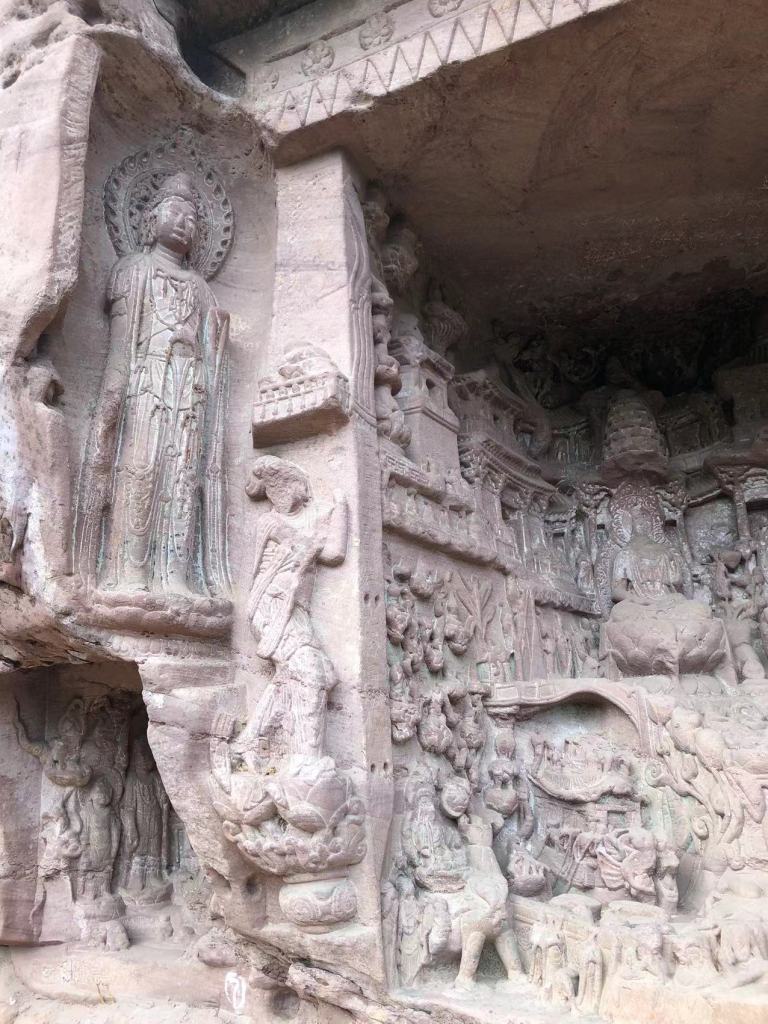
There are a large number of buildings, bridges, ponds and boats in the Stalagmite Mountain Grottoes. Although they directly represent the illusory Buddhist country, they are like a folk paintings, allowing future generations to have a glimpse of the life of the Tang people. With its large scale, exquisite and complete statues, the statues in Shisu Mountain can be regarded as a masterpiece of Sichuan grottoes.
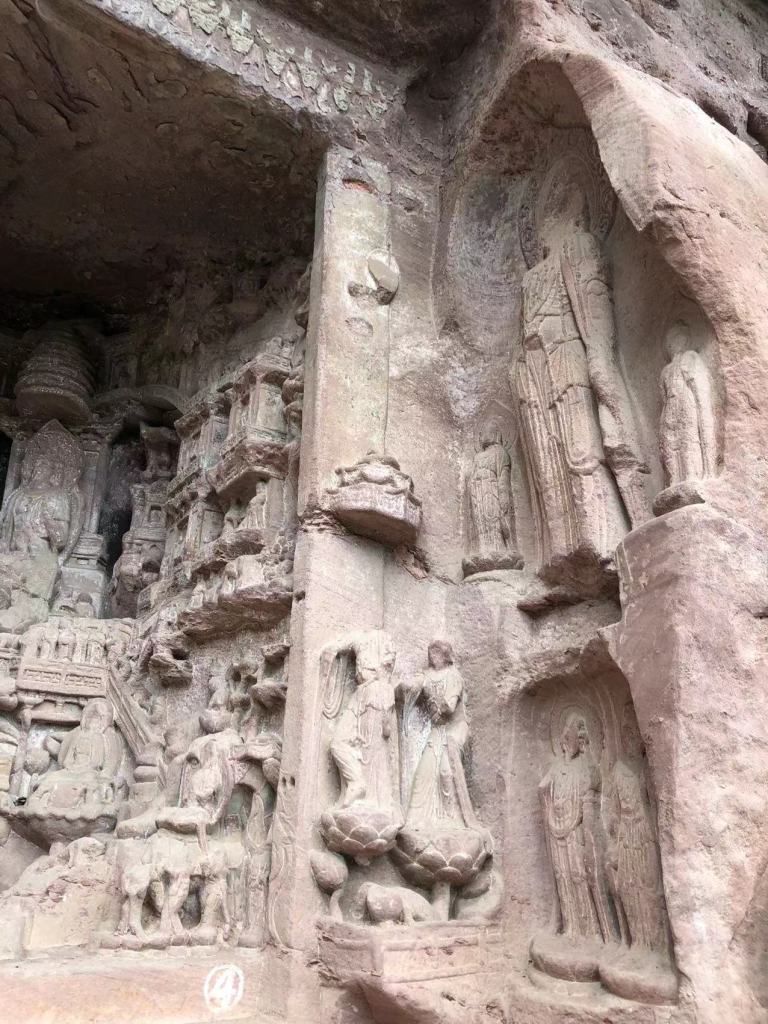
Flowers bloom and fall every year. Who would have thought that after thousands of years, there is only loneliness left? However, it is precise because gradually people left this area that statues were preserved so completely. Chengdu people are so lucky that they can see such beautiful grottoes within about 80 km of the city centre.
Helena Avdjukevica
Used translation from the following articles: https://baike.baidu.com/item/%E8%8A%B1%E7%BD%AE%E5%AF%BA/4808736
 Walk with the Dragon