
On the misty banks where the Pujiang and Linxi Rivers embrace, carved into red sandstone cliffs brushed by time and rain, lies Feixian Pavilion (飞仙阁)—a sanctuary of stone and spirit. Traveling here is not merely a step into history; it is a step into the divine narrative of China’s cultural and religious convergence. As someone endlessly intrigued by China’s imperial women—especially the formidable Wu Zetian—Feixian Pavilion holds a particular enchantment. This place is more than a relic; it’s a living conversation between Buddhism, Daoism, and the human longing for transcendence. Let’s walk together through this sacred gorge, where even time seems to whisper through the chisel marks.
Wu Zetian’s Eternal Offering
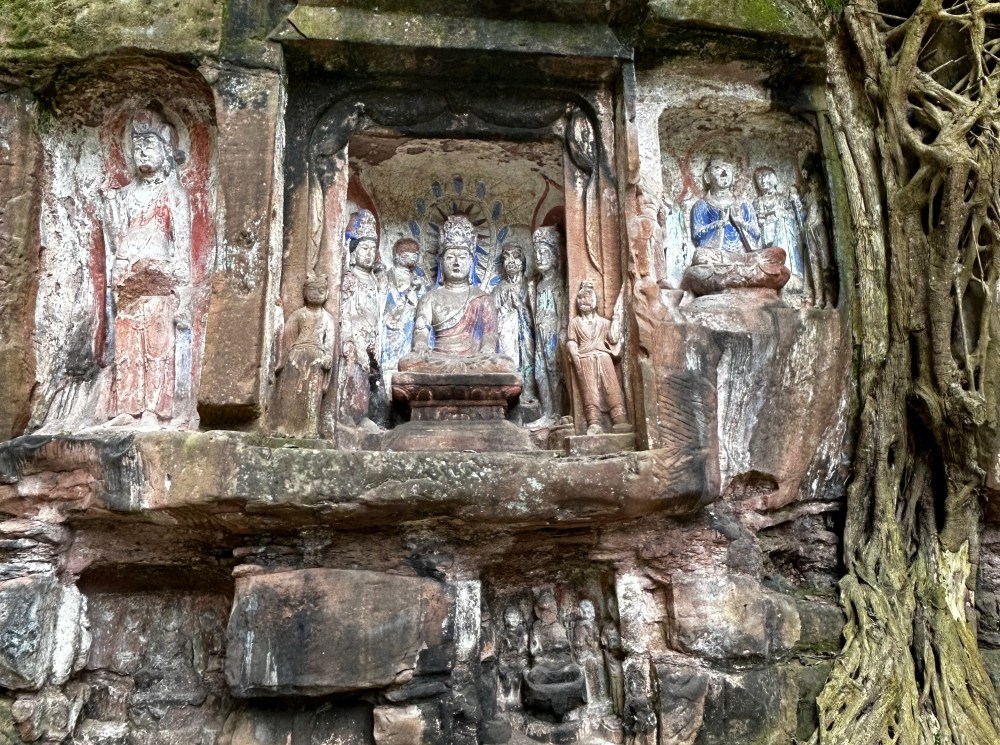
Feixian Pavilion’s most compelling story begins in the sixth year of Yongchang (689 AD), when Empress Wu Zetian, China’s only female emperor, commissioned niches and statues to be carved into these cliffs. The cliffs were located on ancient Tea Horse Road, therefore the rich merchants would stay for prayer, making generous offerings for safe travels.
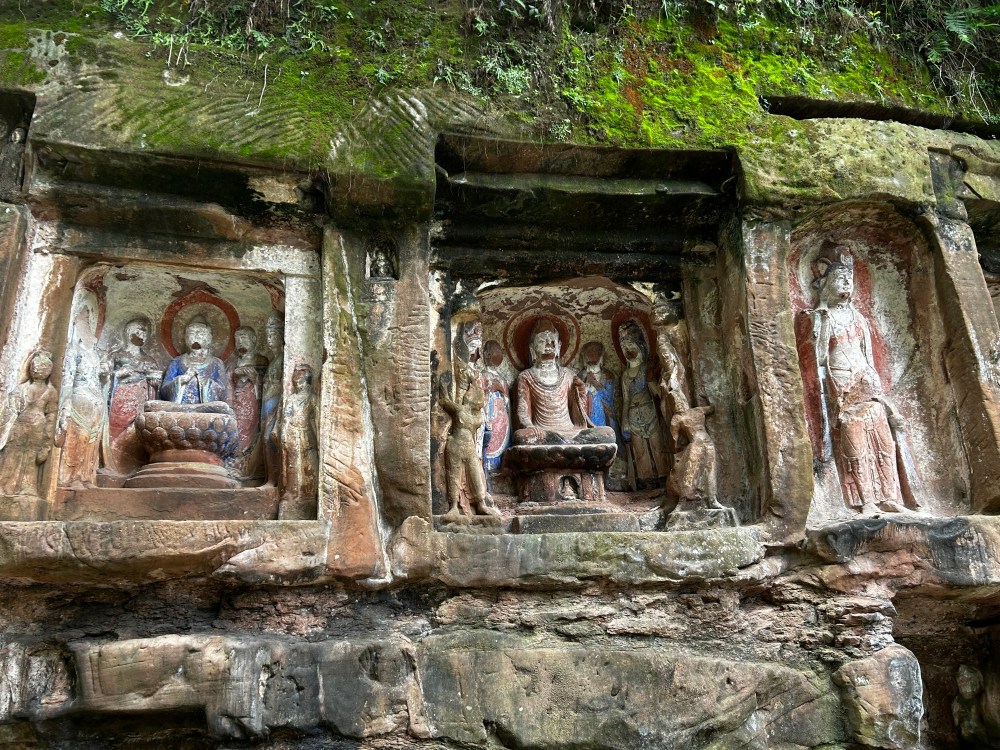
Wu Zetian, known for her brilliant and ruthless consolidation of power, used Buddhism to legitimize her rule. At a time when Daoism was often favored, with the help of White Horse Temple she claimed to be the reincarnation of Maitreya, the future Buddha. Her influence ensured that the Maitreyan imagery spread across Sichuan, leaving behind what we now see as stone testaments to a spiritual-political strategy. The 60th niche at Feixian Pavilion, which depicts a Vishnu Buddha flanked by Bodhisattvas and supporters, depicts the Empress of Heaven—Wu herself. These carvings are not just sacred—they are ambitious. They are the emblems of a woman who bent stone and doctrine alike to her will.
A Gallery of Belief, a Fusion of Faiths
Feixian Pavilion is the largest and best-preserved of the 14 cliff carving sites lining Pujiang’s rivers. With 87 surviving niches and over 550 statues, it’s an open-air museum of devotion that spans the Han to Qing dynasties. You’ll find Buddhas, Bodhisattvas, vajras, warrior guardians, and ethereal flying beings—carved in poses that exude stillness, strength, and sometimes even joy.
What’s fascinating is how Buddhism and Daoism cohabitate here. Some niches feature images of Śākyamuni and Laojun, the Buddha and the Daoist sage, posed side-by-side. According to scholar Christine Mollier, this arrangement was not random—it reflected Tang-era politics, particularly under Emperor Xuanzong who favored Daoism. In these compositions, the Daoist figure is often placed left (yang) of the Buddhist one (right, yin), suggesting an iconographic hierarchy.
Yet here in Pujiang, amid the flowing waters and red rock, these two great faiths coexist without conflict. It’s as though the mountain accepted both paths equally, cradling their visions in stone. It reminded me of Chinese cosmology’s core principle: harmony, not domination.
The Art of Eternity: Cliff Carving as a Spiritual Practice
The craft at Feixian Pavilion is breathtaking. Sculpted from acidic red sandstone, the statues endure not only because of ancient engineering—roofs carved into the cliff to shield them from rain—but also thanks to nature itself. Vines and yellow joggle trees have wrapped the cliff in a protective embrace, shielding the sculptures from erosion.
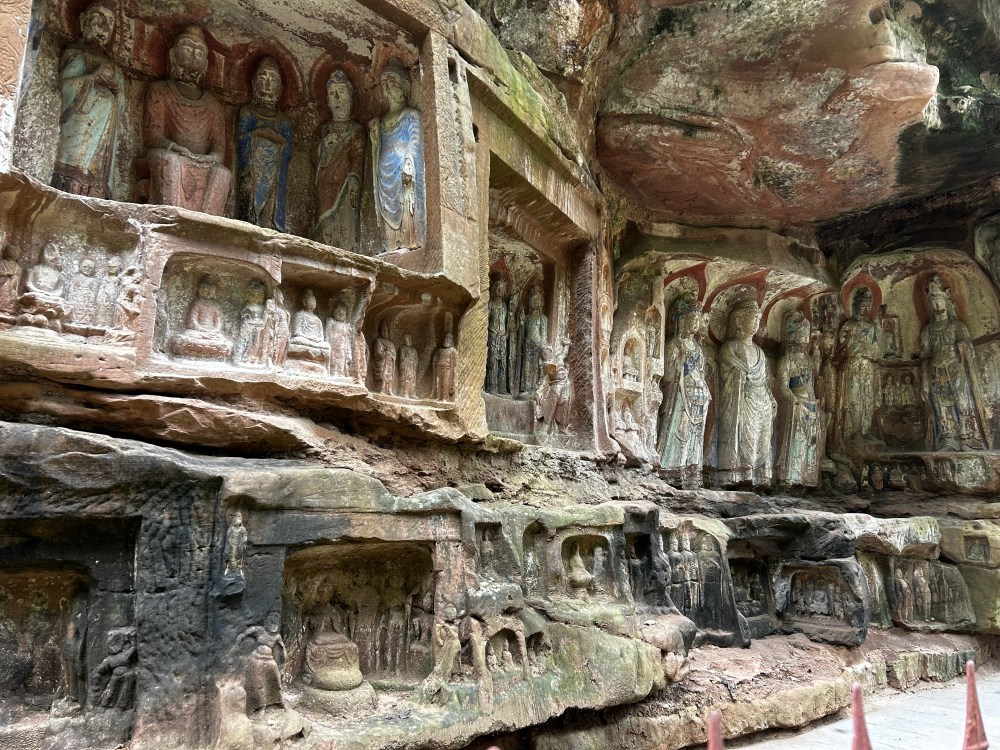
Despite centuries of storms—and even the 2008 Wenchuan earthquake—Feixian Pavilion stood firm. That resilience feels symbolic: the durability of belief, the echo of ancient prayers in modern air. Some of the statues still carry faint colors, whispering of a time when they gleamed with life.
One can trace the Indian and Gandharan influences—the spiral buns, the draped garments, the high relief detailing—yet the interpretation is uniquely Chinese. As art historian Angela Foucault Howard observed, Sichuan craftsmen did not copy, but transformed. They absorbed foreign models and re-expressed them with local sensibilities, creating art that is neither foreign nor native, but a beautiful third thing.
The Buddhist Heartbeat of Feixian Pavilion
Among the many forms of Buddha carved into the cliff, Maitreya, the Buddha of the future, has a notable presence. In Buddhist belief, Maitreya is a figure of hope, a bodhisattva who will appear on Earth to restore dharma when it has been lost. Wu Zetian’s association with Maitreya wasn’t just personal ambition—it tapped into a widespread longing for salvation and renewal.
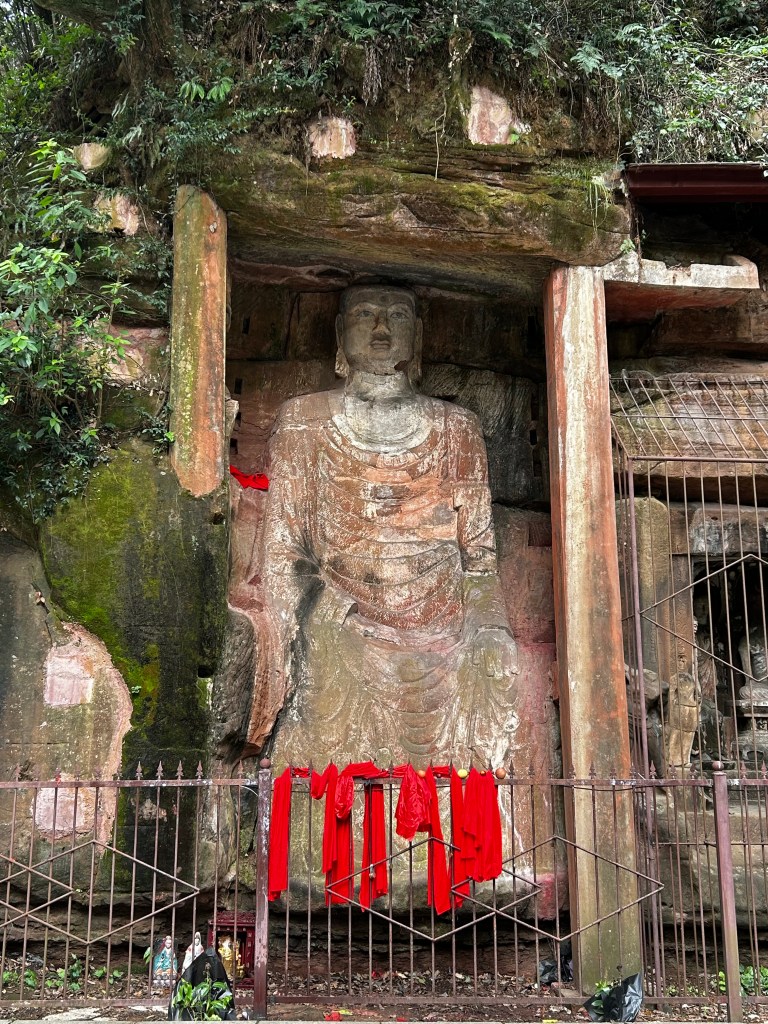
The imagery at Feixian Pavilion also reflects other Buddhist principles: impermanence, as weathering softens sharp lines; interconnectedness, as Daoist and Buddhist icons share space; and compassion, visible in the serene gazes of Guanyin, the bodhisattva of mercy. Even the name “Feixian”—Flying Immortal—evokes the Buddhist idea of transcending the cycle of rebirth, soaring beyond the mundane into enlightenment.
Feixian Pavilion Today: A Place of Quiet Meditation
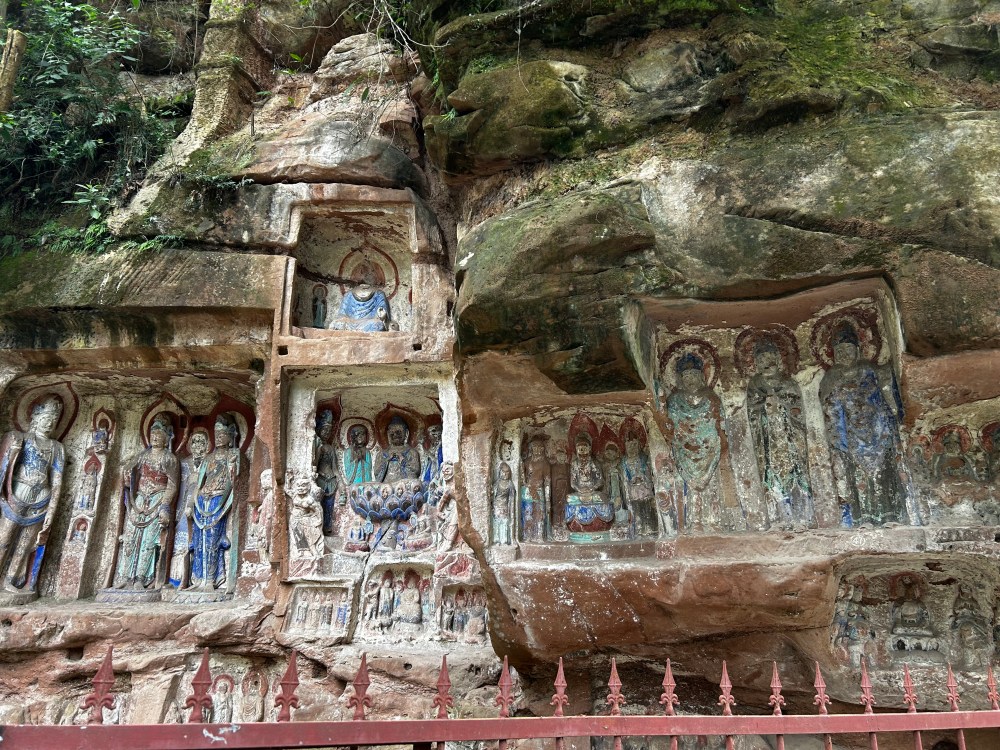
As I stood beneath these cliff statues, with the river murmuring below and the mountain breathing around me, I felt a rare stillness. This quiet place with almost no visitors seems to be a threshold between eras and ideals. In a world obsessed with the next new thing, Feixian Pavilion remains a refuge for the timeless.
The blend of Buddhism and Daoism here is not theoretical—it’s carved in stone. It is a place where beliefs do not compete, but commune. And through it all, the spirit of Wu Zetian lingers: bold, complex, endlessly fascinating. She was born in the North of Sichuan, but left her marks in several Chengdu area places, that are still visible today. If you come here—curious, open-hearted, and a little daring—Feixian Pavilion will reward you. Not just with art, but with the lingering scent of eternity.
Helena Avdjukevica
April 2025
The Buddhist Heartbeat
 Walk with the Dragon